An exploration of the profound correspondences between the Osirian myth and the laws of matter
The ancient Egyptians had neither microscopes nor particle accelerators, yet their cosmology seems to have captured a fundamental truth about the nature of reality. Could the myth of Osiris, Isis, Set, and Horus be a poetic description of the very forces that govern matter?
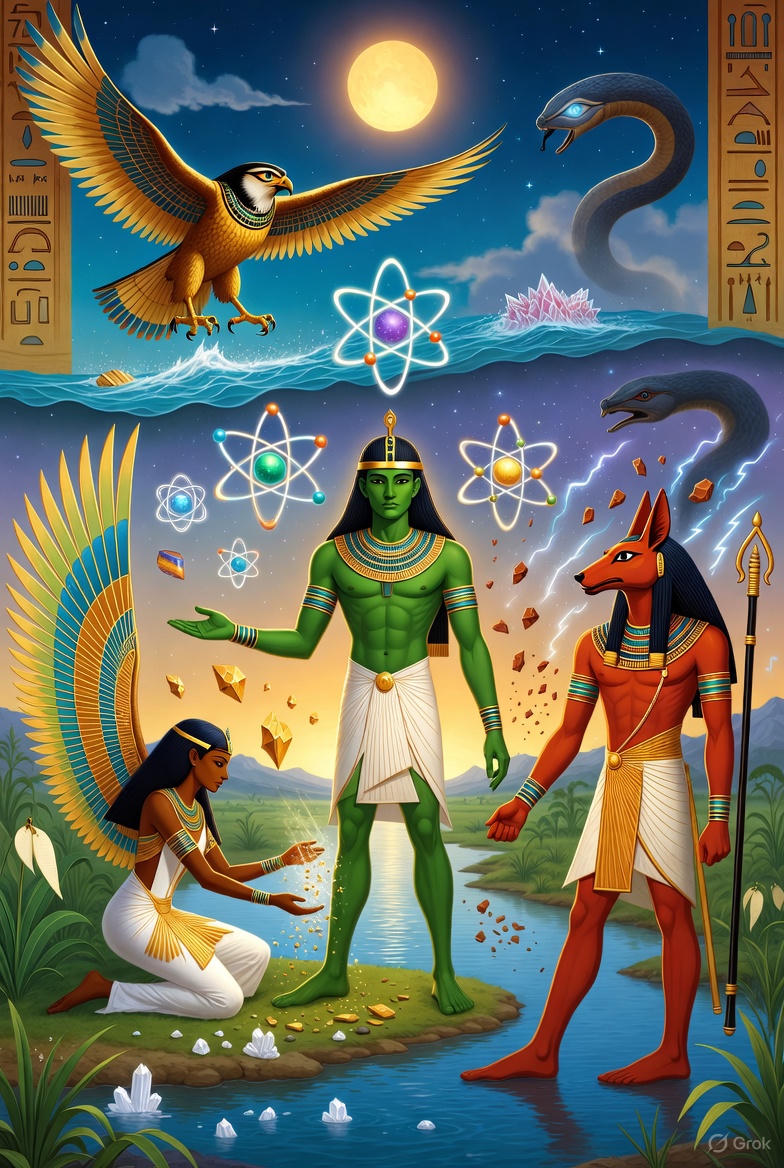
The Four Forces of Matter
Before exploring mythological correspondences, let us briefly recall these four fundamental aspects:
Attraction is the universal force that causes particles to draw closer. It underlies all interactions that create structure and order in the universe.
Repulsion is the antagonistic force that prevents total collapse, maintaining space and distinction between things.
Cohesion is the specific attraction between molecules of the same nature - it is what holds water droplets or salt crystals together.
Adhesion is the attraction between molecules of different natures - it is what allows water to wet glass or salt to dissolve.
Osiris: The Primordial Attraction
In Egyptian cosmology, Osiris is the original king, the principle of order and harmony that governs the cosmos. He represents unity, fertility, the capacity to create coherence from the primordial chaos of Nun.
This description corresponds remarkably to fundamental attraction. Just as Osiris governed unified Egypt, attraction governs the universal tendency of matter to gather, to form stable structures, to create order. Without attraction, no atoms, no molecules, no planets, no life.
Osiris is also the god of perpetual regeneration. Attraction also regenerates continuously - even when fragmented or dispersed by antagonistic forces, it persists and manifests in new forms through its “descendants”: cohesion and adhesion.
Set: The Necessary Repulsion
Set, the red god of chaos and storms, dismembers Osiris and scatters his pieces throughout Egypt. He is the principle of division, separation, destruction of unity.
But here is what is crucial: Set is not purely evil in Egyptian thought. He is the protector of Ra during his nightly journey, the one who combats the serpent Apophis. Set is necessary for cosmic equilibrium.
Repulsion plays exactly this role. It dismembers the unity that attraction would create. It establishes boundaries, maintains space between particles, prevents the collapse of all matter into a singular point. Without repulsion, attraction would cause the end of all distinct existence. Set, like repulsion, creates the very possibility of diversity and multiplicity in the universe.
The conflict between Osiris and Set is not a battle between good and evil, but the dynamic tension necessary for manifest existence - exactly as the balance between attraction and repulsion defines the structure of matter.
Isis: The Restorative Cohesion
After Osiris’s murder, it is Isis who travels Egypt to gather the scattered pieces of her husband. She is the great magician who knows the secret names, the one who maintains together what has been fragmented, who preserves identity through dispersion.
Isis’s quest perfectly embodies cohesion - the force that unites similar things, that restores integrity within the same nature. When water molecules in a drop remain united despite external forces, it is cohesion at work, just as Isis maintains the essence of Osiris together.
Isis does not create a new force - she channels and concentrates Osiris’s power (primordial attraction) to direct it toward restoration of unity. Cohesion does the same: it is a specific manifestation of attraction, directed toward gathering like with like.
The fact that Isis can never completely resurrect Osiris as he was (one piece remains lost) reflects a physical truth: cohesion can never perfectly restore primordial unity. There is always a loss, always an imperfection in the reconstitution.
Horus: The Mediating Adhesion
Horus is born from the posthumous union of Osiris and Isis. He is not simply a restoration of the old order - he is something new, a bridge between domains that were separated. Half-terrestrial, half-divine, Horus reconciles heaven and earth, unites what was divided.
This is precisely the role of adhesion. Where cohesion unites the similar, adhesion creates bonds between different natures. When water adheres to glass, when salt dissolves in water, it is adhesion that allows this communication between distinct substances.
Horus avenges his father by fighting Set, but their struggle is eternal - neither ultimately triumphs. This perpetual battle reflects the constant dynamic between adhesion and repulsion: adhesion seeks to unite differences, repulsion maintains separation. The balance between these forces creates stable interfaces that allow distinct substances to coexist.
Horus is also the mediator who restores cosmic order - not Osiris’s old order, but a new equilibrium. Adhesion does the same: it does not restore primitive unity, but creates new forms of order by enabling collaboration between the different.
Solve et Coagula: The Osirian Cycle
The alchemists used the formula Solve et Coagula - dissolve and coagulate - to describe the fundamental cycle of transformation. The Osirian myth is literally this cycle:
Solve - Set dismembers Osiris. Repulsion disperses what attraction had united. This is the dissolution phase, where structures break down, where order fragments.
Coagula - Isis gathers the pieces. Cohesion reconstructs unity from scattered fragments. This is the coagulation phase, where new structures emerge.
Transformation - Horus is born from this process. Adhesion emerges as a new possibility, creating bridges between what was separated.
This cycle is not linear but eternal. In nature, substances continuously dissolve and coagulate. In the myth, Osiris dies and is perpetually reborn as king of the realm of the dead, while his son continues the cosmic battle in the world of the living.
The Eternal Struggle and Dynamic Balance
A fascinating aspect of this correspondence is that Set and Horus fight eternally in Egyptian mythology. Sometimes Set loses an eye, sometimes Horus loses his testicles, but neither can definitively defeat the other.
This perpetual struggle perfectly reflects the dynamics between repulsion and adhesion in matter. Repulsion seeks to maintain separations; adhesion seeks to create unions between differences. Neither can completely triumph because the balance of matter - and the cosmos - depends on their permanent tension.
Meanwhile, Isis continues her work of maintenance and preservation, just as cohesion constantly maintains the integrity of substances despite dispersive forces.
An Ancient Holistic Vision
What emerges from these correspondences is not just a pretty poetic metaphor. It is the recognition that the ancient Egyptians perhaps intuitively perceived what modern physics has mathematically formalized: the universe is a dynamic game of forces where attraction and repulsion, cohesion and adhesion, dance eternally to create and maintain manifest reality.
Cosmogonic myths would therefore not be naive stories invented by primitive peoples, but sophisticated attempts to describe the fundamental principles of reality using the symbolic language of narrative and divine relationship.
When Egyptian priests told the story of Osiris, were they really talking about anthropomorphic gods in the sky? Or were they describing, in the only language available at the time, the very forces that weave the fabric of existence?
Science and Myth: Two Languages, One Truth
Modern science describes reality with equations and experiments. Ancient myths described it with stories and symbols. But perhaps they describe, fundamentally, the same thing: this eternal game between unity and separation, between order and chaos, between the attraction that gathers and the repulsion that distinguishes.
Osiris is perhaps not “just a myth” and attraction is perhaps not “just a physical force.” They are two ways of naming and understanding the fundamental principles that make the universe as it is - structured but not rigid, ordered but not static, unified but not undifferentiated.
The medieval Alexandrian alchemists, direct heirs of this dual tradition, probably knew this. When they invoked Osiris in their rituals while distilling their substances, they did not separate the spiritual from the material. They recognized that the same laws govern all levels of reality.
Perhaps the next time you see a water droplet beading on a leaf, or salt dissolving in your tea, you will recognize the echo of a five-thousand-year-old myth - and you will realize that the boundary between science and myth, between physics and cosmology, is much more porous than we thought.
For Osiris is never dead. He lives in every atom that unites with its neighbor, in every molecule that maintains its form, in every grain of matter that composes this ever-becoming cosmos.