Geodesic Domes
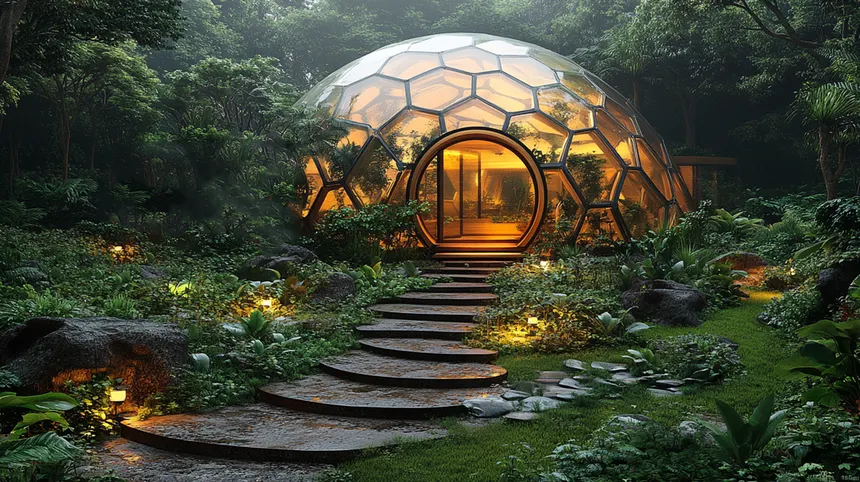
A geodesic dome is a hemispherical thin-shell structure based on a network of triangles that form a geodesic polyhedron. This remarkable architectural design distributes structural stress efficiently across its surface, making it exceptionally strong and stable relative to its weight. The triangular elements provide inherent rigidity, allowing the dome to withstand heavy loads, high winds, and snow accumulation while using minimal materials.
Historical Development
Origins and Innovation
While often associated with R. Buckminster Fuller, who popularized and patented the design in the U.S. (patent 2682235A, granted in 1954), the first geodesic dome was actually designed by Walther Bauersfeld in 1926 for the Zeiss Planetarium in Jena, Germany. Fuller later expanded on the concept, emphasizing its efficiency in using minimal materials to enclose maximum space—a principle he called “doing more with less.”
Fuller’s work transformed the geodesic dome from a specialized planetarium structure into a viable architectural solution for various applications, from residential housing to industrial buildings and public spaces.
Mathematical and Geometric Principles
Geometric Efficiency
The fundamental advantage of spherical structures lies in their geometric efficiency:
This mathematical relationship means a spherical structure encloses the greatest volume with the least surface area, significantly reducing material use and energy loss through the building envelope.
Surface-to-Volume Ratio
Smaller ratios mean better thermal efficiency—favoring larger domes. This geometric principle makes geodesic domes particularly energy-efficient, as they minimize heat transfer through their surface area.
Triangular Stability
The geodesic dome’s strength comes from its triangulated framework. Unlike rectangular structures, which can collapse under pressure due to weak corner joints, triangles resist deformation and distribute forces evenly throughout the structure. The geodesic approach creates a network of triangles that approximately follows the surface of a sphere, providing both strength and geometric harmony.
Structural Features and Materials
Framework Construction
Triangulated Framework: The use of interconnected triangles provides inherent stability. Each triangle shares loads with neighboring triangles, creating a redundant system where no single point bears excessive stress.
Material Options:
- Wooden domes: Use hub-and-strut systems with steel connectors, offering sustainable and aesthetically pleasing solutions
- Steel frameworks: Often made from electrical conduit or tubing, bolted at vertices for industrial applications
- Aluminum and glass: Common in modern designs, allowing for transparent or double-glazed panels
- Concrete/foam domes: Built over a wire-reinforced frame and sprayed with material for monolithic construction
- Polycarbonate panels: Used in prefabricated kits for durability and ease of assembly
Construction Methods
Kit-Based Systems: Many manufacturers offer prefabricated dome kits that can be assembled in under a day without special tools. These systems typically include:
- Precision-engineered struts
- Hub connectors
- Panel systems
- Assembly instructions
Custom Construction: Larger or specialized domes often require custom engineering and on-site fabrication, particularly for unique architectural applications.
Energy Efficiency and Sustainability
Thermal Performance
Due to their reduced surface area-to-volume ratio, geodesic domes lose less heat in winter and gain less in summer. The natural airflow patterns inside the concave interior enhance passive heating and cooling, often reducing energy requirements by 30-50% compared to conventional buildings.
Environmental Benefits
Material Efficiency: The structural efficiency means less material is needed for the same enclosed space, reducing the environmental impact of construction.
Natural Lighting: The curved surface allows for innovative window and skylight placement, maximizing natural daylight while minimizing direct solar gain.
Durability: Properly constructed domes can last for decades with minimal maintenance, reducing the lifecycle environmental impact.
Applications and Examples
Residential Applications
Geodesic domes offer unique advantages for residential construction:
- EcoCamp Patagonia (Chile): Features sustainable geodesic domes designed to withstand extreme winds while providing comfortable living spaces
- Backyard Canada and Hypedomes: Offer 26-foot glamping domes with insulation, ventilation, and off-grid capabilities
- Emergency shelters: Quick assembly and structural strength make domes ideal for disaster relief housing
Commercial and Public Spaces
Greenhouses: Arctic Acres and Growing Domes® offer year-round growing environments, even in cold climates like Canada. The efficient shape and excellent light transmission create ideal growing conditions.
Tourism and Hospitality: Glamping sites and eco-resorts worldwide use geodesic domes for their unique aesthetic and functional advantages.
Public and Cultural Structures:
- Spaceship Earth at EPCOT, Florida (1982): Iconic 18-story geodesic sphere
- Biosphère in Montreal: Originally the U.S. Pavilion at Expo 67, now an environmental museum
- La Géode in Paris: A 36-meter stainless steel dome housing an IMAX theater
- The Eden Project in the UK: Features massive ETFE-clad biomes for botanical conservatories
Advantages and Challenges
✅ Advantages
Structural Strength: Exceptional strength-to-weight ratio, resistant to hurricanes, earthquakes, and heavy snow loads
Energy Efficiency: Reduced surface area and natural airflow patterns decrease heating and cooling costs
Material Efficiency: Uses minimal materials to maximum space advantage
Fast Assembly: Kit-based systems can be assembled quickly without specialized equipment
Versatility: Suitable for residential, commercial, industrial, and public applications
Aesthetic Appeal: Unique and striking architectural form that stands out from conventional buildings
❌ Challenges
Complex Geometry: The non-standard shape can create challenges for:
- Waterproofing: Every strut intersection is a potential leak point if not properly sealed
- Furniture placement: Curved walls make traditional furniture arrangement difficult
- Interior finishing: Drywall and conventional finishing methods require adaptation
Higher Initial Costs: Custom engineering and specialized components can increase upfront costs compared to conventional construction
Limited Architectural Integration: Connecting domes to traditional rectangular buildings requires careful design solutions
Building Code Compliance: Some jurisdictions have limited experience with dome construction, potentially complicating permitting processes
Market Acceptance: The unconventional design can face resistance from conservative markets or financing institutions
Modern Innovations
Advanced Materials
Bioceramic Composites: Bioceramic domes represent the latest evolution in dome technology, offering fire-, flood-, and mold-resistant properties that can potentially last 500 years.
Smart Materials: Integration of phase-change materials, electrochromic glass, and responsive insulation systems enhances energy performance.
Sustainable Materials: Development of bio-based composites, recycled content, and low-carbon footprint materials for dome construction.
Technological Integration
Automated Manufacturing: Computer-aided design and manufacturing (CAD/CAM) allows for precision production of dome components with minimal waste.
Smart Home Integration: The unique geometry of domes lends itself well to integrated automation, environmental control, and energy monitoring systems.
3D Printing: Emerging technologies enable the direct printing of dome structures using various materials, potentially revolutionizing construction methods.
Design Considerations
Site Planning
Orientation: Proper solar orientation maximizes passive heating and cooling benefits while optimizing natural light.
Foundation Requirements: The efficient load distribution of geodesic domes often requires less substantial foundations than conventional buildings.
Landscaping Integration: The organic shape of domes can integrate harmoniously with natural landscapes, minimizing visual impact.
Interior Design
Space Planning: Creative use of curved walls and multi-level layouts can maximize usable space while maintaining the dome’s aesthetic integrity.
Acoustic Considerations: The curved surfaces can create unique acoustic properties that may require treatment for certain applications.
Ventilation Systems: Natural convection patterns within domes can be harnessed for passive ventilation, reducing mechanical system requirements.
Related Concepts
- Bioceramic Domes: Modern innovation in dome materials technology
- Organic Architecture: Design philosophy aligned with dome principles
- Open Collaborative Spaces: Community applications of dome architecture
- Permaculture: Sustainable systems integration with dome design
- Biomimicry principles in architectural design
- Tensegrity structures and advanced geometric engineering
References
- Fuller, R. Buckminster. Synergetics: Explorations in Geometry. 1975.
- Bauersfeld, Walther. “Construction of the Planetarium.” Zeiss Archives, 1926.
- Kenner, Hugh. Geodesic Math and How to Use It. 1976.